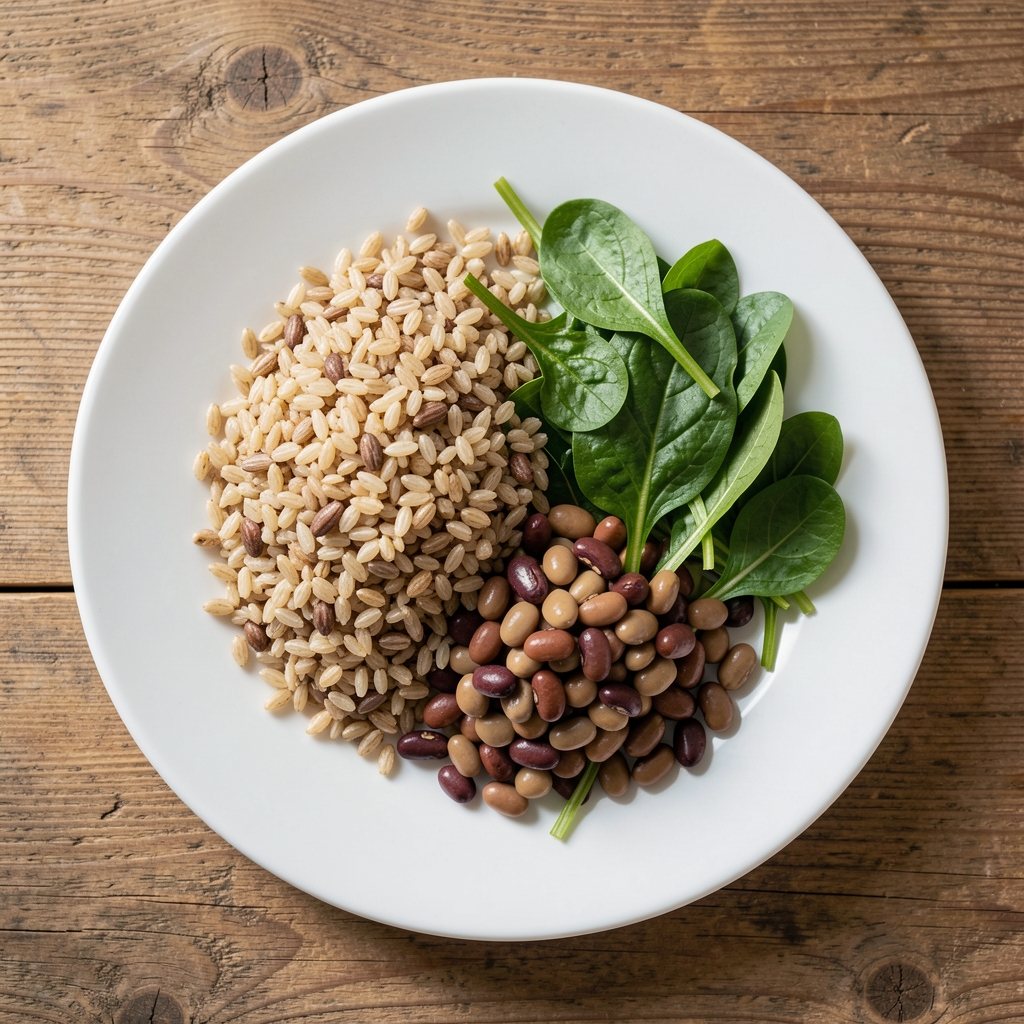
Observing Portion Size as a Variable in the Daily Food Record
Portion size sits at the intersection of habit, attention, and environment. It is rarely decided in advance; it emerges from the size of the container, the density of the food, the degree of hunger at the time of eating, and the social context of the meal. The following observations draw on a twelve-week daily food record in which portion size was tracked not through weighing or calorie attribution, but through a structured visual notation system — one that recorded relative volume in relation to a reference bowl and plate.
Notation Without Measurement
The notation system used in this record assigned each meal component a relative volume score from one to five. A score of one indicated a small portion — less than the reference volume. A score of five indicated a serving substantially larger than the reference. The system was established at the outset of the record using a 300ml bowl and a 26cm plate as physical anchors, both photographed for reference. From that point, every meal entry included a notation for each component present.
The advantage of this approach over gram-weight recording is speed and consistency. A notation takes three seconds per component. Weighing food, by contrast, interrupts the flow of meal preparation and tends to be abandoned within the first week of recording in most observational contexts. The disadvantage is precision — a score of three can represent a moderately wide range of actual volumes. For the purposes of pattern recognition rather than precise energy accounting, this imprecision was acceptable.
The record captured three meals per day and any between-meal eating. It ran from late November to mid-February, spanning a period that included the winter holiday weeks and the January resumption of a standard working routine. These transitions created natural breaks in the data that proved useful for comparative analysis.

Patterns in Portion Variation Across the Week
The most consistent pattern in the record was a weekly cycle of portion variation. Monday and Tuesday meals were consistently smaller across all notation scores — a reflection, the record-keeper reported, of a deliberate tendency to eat more lightly after the weekend. By Thursday and Friday, portion scores increased, particularly at dinner. Weekend meals showed the highest variability: Saturday dinner was frequently the largest meal of the week, while Sunday lunch was often the most structured and moderate.
This weekly rhythm has a nutritional logic. The body's energy requirements do not vary substantially across the days of the week in a person with a consistent activity level. What varies is the social and temporal context of eating — the availability of time for longer meals, the presence of others at the table, the emotional register of the day. Portion size, in this record, tracks social context as much as hunger.
The implication for weight awareness is measurable. During weeks when Saturday dinner and Sunday lunch both registered high portion scores (4 or 5) across multiple components, the Monday morning weight reading was consistently 0.6 to 1.1 kg above the Friday reading. This difference largely resolved by Wednesday — consistent with normal fluid and glycogen variation — but it was reliable enough to appear in the data on nine of the twelve weeks recorded.
"Portion size, in this record, tracks social context as much as hunger."
The Holiday Period as a Natural Experiment
The four weeks spanning the winter holiday period constituted the most instructive section of the record. Three distinct patterns emerged. In the first week of December, ahead of the holidays, portion notation was unremarkable — the standard weekly cycle continued. During the two central holiday weeks, portion scores increased substantially and the weekly structure dissolved. Meals became irregular in timing, larger in portion, and more mixed in composition.
In early January, the record showed a sharp but brief return to notably smaller portions — a pattern consistent with a self-corrective response to the holiday weeks rather than a deliberate nutritional plan. This self-correction was short-lived. By the second week of January, portions had stabilised back toward the pre-holiday baseline without requiring deliberate effort. The body's appetite regulation, in this record, functioned as a natural moderating force when the disruption of the holiday period was clearly bounded in time.
The weight record across this period showed a corresponding pattern: an increase of 2.2 kg during the holiday weeks, a partial reduction in early January, and a full return to the pre-holiday weight by the end of January. The gradual nature of this return is consistent with a whole-foods-based diet that does not include a caloric restriction strategy — the return was structural rather than intentional, driven by the resumption of normal meal rhythm rather than active reduction.
Slow Eating and Portion Completion
A secondary variable in the record was meal duration — the approximate time from first bite to last, recorded in five-minute intervals. The intention was not to impose slow eating practice but to observe whether duration correlated with portion completion or incompletion. Portion completion was defined as consuming the full notation score of food placed on the plate; incompletion was defined as leaving a measurable portion uneaten.
The finding was consistent across all twelve weeks: meals lasting 25 minutes or longer showed a higher rate of incompletion than meals lasting under 15 minutes. This is consistent with established nutritional observation that satiety signals — the sense of fullness between meals — reach perceptual awareness on a delayed basis. Meals consumed rapidly outpace those signals; meals consumed slowly allow them to register before the plate is empty.
The practical significance of this is modest but reproducible. The record shows that on weeks where meal duration was consistently above 20 minutes — weeks that coincided with working from home and uninterrupted lunch breaks — portion scores at dinner were lower. The midday meal, when it was slow and complete, appeared to dampen appetite at the subsequent meal. This interaction between meals, operating through the mechanism of satiety rather than restriction, produced a measurable shift in daily portion patterns.
Food Journalling as a Feedback Mechanism
The central value of a food journal is not the data it produces. It is the attention it requires. The act of recording a meal — noting its components, estimating their volume, recording the time — creates a brief moment of reflection that does not occur in undocumented eating. This reflection does not alter every meal, but across twelve weeks, its cumulative effect is legible in the record.
The record-keeper reported, at the close of the twelve weeks, that the most significant change in their eating behaviour was not any specific food choice or portion decision. It was the development of a continuous awareness of what they were eating and when. This awareness, which the record both required and reinforced, constituted a sustained shift in the relationship between the person and their food — less automatic, more deliberate, not in the sense of restriction, but in the sense of attention.
The weight record across the twelve weeks showed no dramatic change. The person began at the same weight they finished. What the record documents is not a weight-change story but a nutritional-awareness story: the structure that emerges when daily eating is brought into view, and the modest, consistent patterns that become visible only when the data accumulates over time.
- 01 Visual notation (1–5 relative volume) is more sustainable than weighing for long-term food records.
- 02 Portion size follows a weekly social rhythm, not a hunger rhythm — largest on Saturday, most moderate on Sunday lunch.
- 03 Holiday weight gain of 2.2 kg resolved naturally within four weeks without active restriction.
- 04 Meals lasting 25+ minutes showed higher incompletion rates — satiety signals reached awareness before the plate was empty.
- 05 The primary outcome of food journalling was sustained nutritional awareness, not a specific weight change.

Tobias Marsden contributes to Keldova Almanac as a guest writer with a background in behavioural nutrition. His work focuses on the observable patterns in everyday eating and the practical value of sustained food recording.
More from this publication →